Professional Keyboard Buying Guide
What separates a $1,500 keyboard from a $4,000 one? Here's what you need to know.
Sampling vs. Modeling: What's the Difference?
Sample-Based (Yamaha, Kawai):
- How it works: Records actual concert grands note-by-note at multiple velocities. Multi-layer stereo sampling captures soft, medium, and loud playing separately.
- Pros: Authentic traditional piano tone, predictable sound, lower processor requirements
- Cons: Limited polyphony (256 typical), sounds "loop" at extreme dynamics
- Enhancement: Yamaha adds VRM (Virtual Resonance Modeling) for sympathetic string resonance. Kawai uses resonance algorithms.
- Best for: Classical players, those who prioritize traditional acoustic piano sound
Real-Time Modeling (Roland):
- How it works: Generates sound mathematically in real-time based on physics of piano string behavior. Every note is unique.
- Pros: Unlimited polyphony, infinite tonal variation, incredibly responsive to touch nuance
- Cons: Requires significant processing power, some find tone less "traditional"
- Technology: Roland's PureAcoustic and Piano Reality Concert modeling
- Best for: Jazz players, those who prioritize touch responsiveness over traditional tone
Our take: Both are excellent at this level. Sampling sounds more like "a specific piano," modeling feels more responsive to your playing. Try both if possible.
Portable vs. Console for Professionals—Which Makes Sense?
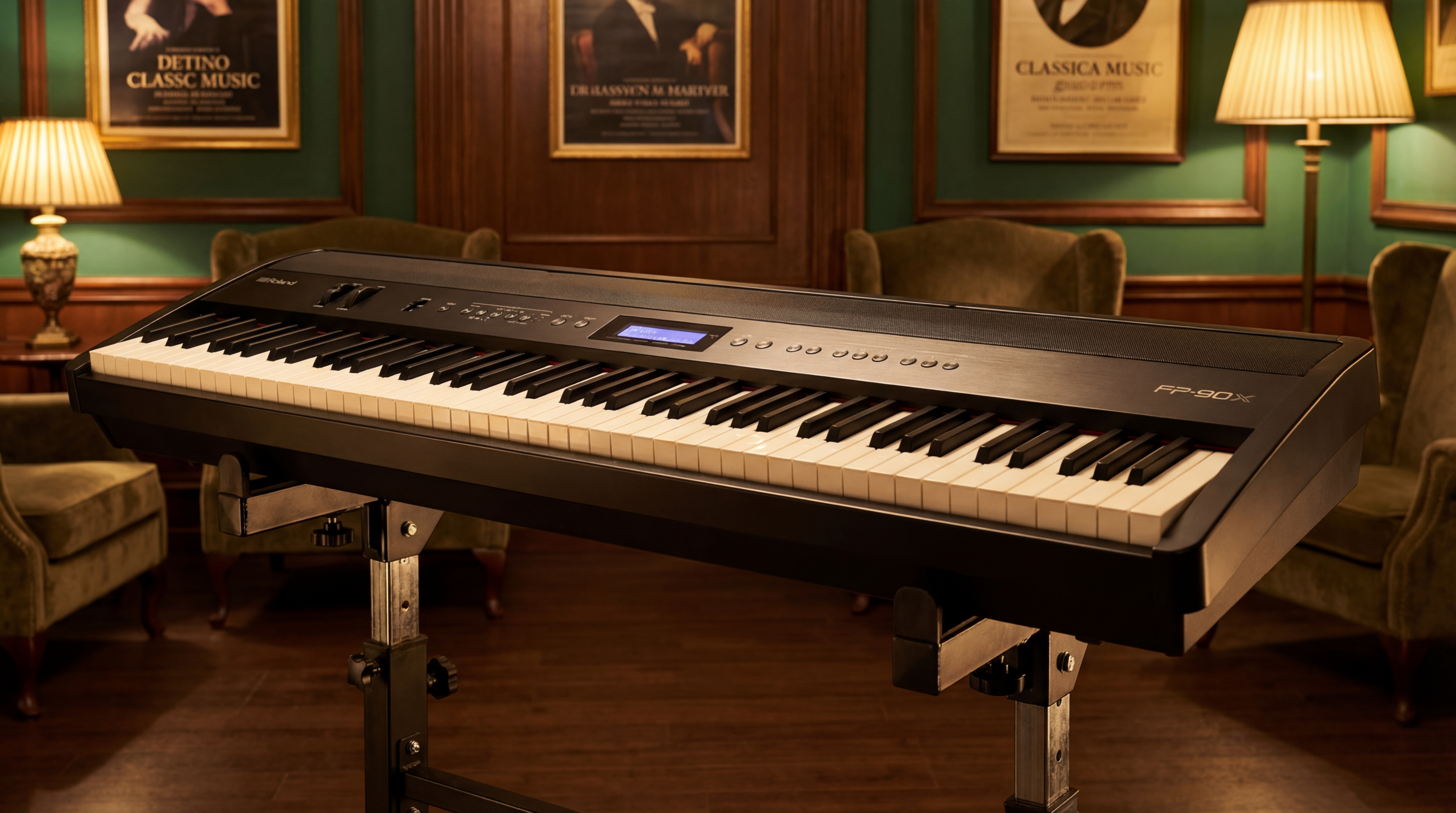
Portable Flagships (P-515, ES920, FP-90X):
- Pros: Take to gigs, teaching studios, recording sessions. Typically $1,000-$1,500 less than equivalent console models. Can upgrade stand/pedals later. Easier to sell/transport if you move.
- Cons: Typically need high-quality stand ($150-300) and pedals ($100-200). Speaker placement not optimized for room acoustics.
- Weight: 37-55 lbs (manageable for one person)
- Choose if: You gig professionally, teach at multiple locations, or want maximum flexibility
Console Models (CLP-745, CA99, LX-706):
- Pros: Superior speaker placement (downward-firing, bass reflex, multi-way systems). Optimized cabinet acoustics. Premium 3-pedal systems with progressive resistance. Looks like acoustic grand. Better resale (furniture piece).
- Cons: Not portable (100-150+ lbs assembled). Requires dedicated floor space. Higher initial investment.
- Choose if: This is your primary home instrument, you have dedicated space, acoustic-like presence matters
Is Wooden Key Action Actually Worth It?
Yes—at professional level, it makes a measurable difference:
- Consistency: Wooden keys have more uniform weight distribution than plastic. Every key feels identical.
- Moisture absorption: Wood absorbs finger moisture, providing better grip during long practice sessions. Less slipping with sweaty hands.
- Tactile feedback: Subtle "give" in wood replicates acoustic piano feel more accurately
- Long-term stability: Wood doesn't warp or change feel over time like plastic can
- Acoustic-like inertia: Wood has similar mass properties to acoustic ivory/ebony
Models with full wooden keys: Yamaha P-515 (NWX), Clavinova CLP-745+ (GrandTouch-S), Kawai CA99 (Grand Feel III). Roland uses hybrid wood/molded composite in PHA-50.
Our take: If you're spending $1,500+, wooden keys are worth prioritizing. The difference is subtle but becomes obvious over months of playing.
Do I Really Need a $4,000 Digital Piano?
Consider top-tier models ($3,500-4,000) if:
- This is your primary instrument: You practice 2+ hours daily and plan to keep this for 10+ years
- You're a professional: Performer, teacher, or recording artist who needs the absolute best
- You're replacing an acoustic grand: Comparable quality to $15,000-20,000 acoustic uprights
- You want the best available: Speaker systems, key actions, and sound engines at this level have no compromises
- Future-proofing: These instruments won't feel "outdated" for a decade or more
Stick with $1,500-2,500 range if:
- You gig frequently: Portable flagships (P-515, ES920, FP-90X) offer 90% of the performance at lower cost and weight
- Space is uncertain: If you might move apartments/homes, portables are more practical
- You're still advancing: Diminishing returns above $2,000 unless you're at conservatory level
- Budget flexibility matters: The extra $1,500-2,000 could go toward lessons, acoustical treatment, or quality audio interface
The honest truth: Kawai ES920 ($1,799) has key action comparable to keyboards 2x its price. Yamaha P-515 ($1,599) delivers 85-90% of what the Clavinova CLP-745 ($2,699) offers. The top-tier models are phenomenal but not essential unless you're at the highest playing level or want absolute no-compromise quality.